Ireland

Dublin Hit or Miss

Although we spent only two and a half days in Dublin, we covered most of the main sights. In earlier posts I told you about the Book of Kells, the Long Room at Trinity College Library, and the National Museum. These were all a hit with us and I recommend taking the time to visit each. There were lots of other hits with us, too. Here is a summary of some of the other sights we visited in no particular order.

The Guiness Storehouse was a hit and frankly, I was surprised. We didn’t tour it last time we were in Dublin but after reading its the number one tourist attraction in all Ireland, I thought we should take a look. I’m glad we did because this was a fascinating museum. In 1759, Arthur Guinness signed a 9,000 year lease to pay 45 pounds a year for St. James Gate Brewery. You can see the lease encased in glass in the floor of the lobby. Plenty of educational materials displayed on seven levels explained the history and the beer-making process. I’m not a beer drinker, in fact I’m normally gluten-free, but I made an exception in this case to taste a pint at the end of the tour. I was impressed.

Guinness Storehouse

Guinness Storehouse

This says it all.

This says it all.

The Cooperage Exhibit showed Jim's favorite video explaining the barrel making process

The Cooperage Exhibit showed Jim’s favorite video explaining the barrel making process

Brian and Abi tasting a pint in the Gravity Bar at the top of the Guinness Storehouse

Brian and Abi tasting a pint in the Gravity Bar at the top of the Guinness Storehouse

Tasting our pint in the Gravity Bar at the end of the tour of the Guinness Storehouse

Tasting our pint in the Gravity Bar at the end of the tour of the Guinness Storehouse

The Dublin Castle was definitely a hit. We took the guided tour and found it interesting and helpful even though Rick Steves called it boring.  In fact, it seemed like three separate tours, and visits to two of the areas, the undercroft below the castle and the State Apartments, are allowed only by guided tour. First, we toured the level under the castle (undercroft) where the original Viking fortress was located at the juncture of the Liffey River and its tributary, the Poddle, in a black pool, or dubh linn in Irish (Dublin). This level was excavated in 1986 revealing archeological evidence from around 930 AD Viking Dublin and Norman remains from the 12th century.

Dublin Castle

Archeological dig under Dublin Castle

Dublin Castle

The Irish dubh linn (Dublin) which means black pool under Dublin Castle

Dublin Castle was the symbol and center of British colonial rule in Ireland. The Chapel Royal displays the coats of arms of all the  British officials assigned to rule Ireland from 1172 until the last space was filled in 1922, coincidentally, the same year  the Republic of Ireland gained independence from Britain.

The Royal Chapel at Dublin Castle

The Royal Chapel at Dublin Castle

The coats of arms surrounding the perimeter of the Royal Chaple at Dublin Castle

The coats of arms around the perimeter of the Royal Chapel at Dublin Castle

Pipe Organ given to the Royal Chapel by Queen Victoria's consort, Prince Phillip

Pipe Organ given to the Royal Chapel by Queen Victoria’s consort, Prince Albert

The last stop on the tour was at the State Apartments where official state functions are held to this day. During the colonial period, the Viceroy lived there and on occasion the King or Queen would visit. The throne that was built for King George IV’s visit in 1821 was so large, the diminutive Queen Victoria subsequently had a step added.

Throne with Step for Queen Victoria in the Throne Room, Dublin Castle

Throne with Step for Queen Victoria in the Throne Room, Dublin Castle

The Drawing Room was the scene of many glittering extravaganzas during Dublin’s social season which culminated in the Grand Ball on St. Patrick’s Day. Debutantes would line up from the most wealthy to the least with the width of their ball gowns as an indication of wealth and status.

The Drawing Room, Dublin Castle

The Drawing Room, Dublin Castle

The Chester Beatty Library was a delightful hit. Chester Beatty, born in 1875, was an American who moved to England in 1911, then to Ireland in 1950 where he established a library to house his priceless collection of rare books, manuscripts, paintings, and objets d’art from around the world. This museum strikes the right note allowing a leisurely visit that impresses without overwhelming the visitor. While photography is not allowed, the museum is free. Thanks to my friend, Sheryl, for recommending a delight we would have otherwise missed.

Chester Beatty Library, Dublin

Chester Beatty Library, Dublin

A walk through St Stephen’s Green was a welcome hit. The day was warm and sunny, drawing swarms of people to enjoy a perfect day lounging on the green enjoying the colorful flowers and wildlife.

Lounging in St. Stephen's Green

Lounging in St. Stephen’s Green

St Stephen's Green

St Stephen’s Green

Fountain at St Stephen's Green

Fountain at St Stephen’s Green

Swan in St. Stephen's Green

Swan in St. Stephen’s Green

St Patrick’s Cathedral was a sacred hit. Much of what is known of St. Patrick, the patron saint of Ireland, consists of legend rather than fact. One of the legends is that he baptized new converts to Christianity at a well in the cathedral environs. In 1901, six gravestones were unearthed and one of them covered what appeared to be a well, more “proof” that St. Patrick had indeed baptized converts there in the fifth century.

Jonathan Swift, the satirist who wrote Gulliver’s Travels and A Modest Proposal, was the Dean of the Cathedral from 1713-1745 and is buried here.

St. Patrick's Cathedral

St. Patrick’s Cathedral

St. Patrick's Cathedral

St. Patrick’s Cathedral

St. Patrick's Cathedral, Dublin

St. Patrick’s Cathedral, Dublin

Grave slab from St. Patrick's Cathedral

Grave Slab that covered an old well where St. Patrick was reputed to have baptized converts

The Temple Bar area was a hit both day and night. Temple Bar is both a pub and an area of Dublin. Whether you are seeking a pint of Guinness, authentic traditional music, or pub grub, you’ll find it in Temple Bar.

Iconic Temple Bar, Dublin

Iconic Temple Bar, Dublin


Temple Bar

Temple Bar

Temple Bar

Temple Bar

Unfortunately, Dublinia was a miss. This is an experiential museum about Viking and Medieval Ireland and the information was interesting but the museum is a series of re-creations with no authentic artifacts. Photography is not allowed, possibly because no one would visit if they saw what’s there… or not there. Admission is 8.5 Euro which seems expensive compared to the National Museum which was free. To be fair, I read reviews on TripAdvisor and plenty of others (including my husband) think it’s great.

Two more iconic sights in Dublin absolutely have to get a mention here. The statue of Molly Malone was gifted to the city in 1988 and to be sure, it was a challenge to find her this time around. She’d been moved because of a construction project.

Molly Malone

Molly Malone

The Ha’penny Bridge over the Liffey is as Irish as a pint of Guinness. Officially named the Liffey Bridge, it’s always been called the Ha’penny Bridge after the toll of a half penny that was originally charged to cross it.

The Ha'penny Bridge over the River Liffey

The Ha’penny Bridge over the River Liffey

Be sure to stop by again next week when we will finally venture beyond the pale. I’ll also explain what that means for those who don’t know.

Based on events from April, 2015


Categories: Ireland | Tags: , , , , , , , , , , , , , | 5 Comments

Synchronicity in Dublin

Have you ever heard of synchronicity? It’s a term coined by Carl Jung which means “the simultaneous occurrence of events that appear significantly related but have no discernible causal connection.” (Google)  For example, I recently phoned my husband when I was out-of-town watching my niece and nephew and told him we were having brat patties, baked potatoes, and baked beans that evening for dinner. He laughed and told me he, too, was having brats, baked potato, and baked beans for dinner. We eat brats about once a year; not a frequent occurrence, by any means. Honestly, this type of coincidence happens fairly often to me. Another example is when you say you haven’t seen so and so in a long time and they show up right afterward.

That’s the kind of situation that occurred recently while we were in Dublin. My son and daughter-in-law decided to check out a book store of rare and antiquarian books called Ulysses Rare Books and invited my husband and me along. Many years ago we lost an obscure book of writings by an Irish ancestor of my husband’s from the early 1800’s and we thought we’d inquire about it just on the off-chance this shop had the book.

When we walked in, I addressed the woman at the desk and said, “We’re looking for a book entitled James Fintan Lalor. He was an obscure agrarian reformer from the 1800’s.” The look on her face was incredulous. She said, “I can’t believe it, but I’m at this very moment cataloguing a book by that name.” She showed me her computer screen and indeed it had the name James Fintan Lalor on it. What do you think the odds are that a man named James Lalor (my husband) would walk into a book store when his name is on the computer screen in that shop? I can tell you, the shop keeper and we were totally shocked by this synchronicity. Although the book she held was not the particular one we sought, we had quite a discussion about it and we ended up buying a first edition of another book about James Fintan Lalor.

Proprietress at Ulysses Rare Books

Proprietress at Ulysses Rare Books

Ulysses Rare Books

Brian and James at Ulysses Rare Books

If you travel to Dublin and you’re a book lover, stop by this delightful shop at 10 Duke Street. The proprietors are brother and sister and their father had the shop before them. Specializing in 20th century Irish literature, they have many rare editions and although I’m not a book collector, I loved perusing the stacks here.

What kind of synchronistic experiences have you had?

Based on events from April, 2015.

Categories: Ireland | Tags: , , , , | 3 Comments

Sláinte

When you raise your pint of Guinness for a toast in Ireland, you say Sláinte, meaning good health. Click below to learn to say it properly.  

I have several pub stories from our trip to Ireland but this one merits singular treatment. Based on outstanding reviews by Anthony Bourdain, we decided to eat at John Kavanagh’s Pub. Kavanagh’s is referred to locally as the Gravedigger’s due to its proximity to the Glasnevin Cemetery, where Irish heroes such as Daniel O’Connell, Charles Stewart Parnell, and Michael Collins are buried. As we approached the door, a gentleman outside inquired whether we were there to eat or drink. We said, “Both,” to which he responded, “If you want food, go in that door. If you want history, go in this one.” We opted for the food door but once inside, the waitress told us there was no food on Mondays. So, back outside and in through the history door we went. We love both food and history so if one isn’t available, the other will do.

This pub was first licensed in 1833 and continues to be a local institution to this day. Although not the oldest pub in Ireland, (that distinction belongs to The Brazen Head), John Kavanagh’s has been in the same family for six generations. It didn’t take long for the friendly locals inside to engage us in conversation. These guys are a garrulous group with many tall tales to tell. The most memorable was when they heard we were from Iowa, one of the chaps asked, “Which is closer, Iowa or the moon?” Providing the punchline, he exclaimed, “The moon. You can see the f_ _ _ _ _’ moon! You can’t see Iowa from here.”

These fellows are also very proud to show off a book kept on the premises that contains information about the pub including the many movies in which the pub has appeared such as “The Woman Who Loved Clark Gable,” “No One Would Save Her,” “Quackser Fortune Has A Cousin in the Bronx,” and “Strumpet City.” Honestly, I hadn’t heard of any of these movies, but maybe you have. The pub even has its own friendly ghost, reputed to enjoy a pint of Guinness as much as other loyal customers. I didn’t get the name of the book but if you visit, I’m sure they’d be proud and happy to share it with you.

John Kavanaugh's Pub, Dublin

John Kavanagh’s Pub, Dublin

Kavanaugh's Pub

Kavanagh’s Pub

Kavanaugh's Pub

Kavanagh’s Pub

Friendly customers at Kavanaugh's

Friendly locals at Kavanagh’s

Friendly customers at Kavanaugh's

Friendly locals at Kavanagh’s regaling Jim with stories

Friendly customers at Kavanaugh's

Friendly local at Kavanagh’s with Abi and Brian

Swinging Doors that locals told us are famous from movie appearnaces (Photo provided by Abi)

Swinging Doors that locals told us are famous from movie appearances (Photo provided by Abi)

We went to other pubs in Dublin and throughout Ireland but this pub was the only place where we didn’t rub shoulders with other tourists seeking an authentic Irish pub experience. This was the real thing.

I’d be remiss, however, if I didn’t go back to tell you about the food that originally brought us there. Click on this youtube video to see what they’re doing with tapas at Kavanagh’s. We’ll be back to check it out—but not on a Monday.

Categories: Ireland | Tags: , , , , , | 7 Comments

Bog Bodies and More at the National Museum of Ireland

The National Museum of Ireland – Archeology has an amazing collection of over 2 million artifacts, they allow photography, and it’s free. What more could a history nerd ask for? This is an outstanding museum, in a beautiful facility with good explanations and well presented displays. The museum is closed on Mondays but fortunately for us, we were there on Sunday when they are open from 2-5.

National Museum of Ireland - Archeology

National Museum of Ireland – Archeology

I was especially interested in the Clontarf 1014 exhibit about Brian Boru and the Battle for Dublin because our son, Brian, is named for the high king and we were staying at the Clontarf Castle. For more on that, read my earlier post here. The exhibit debunked the legendary version of the Battle at Clontarf with well-researched and compelling information. While no archeological evidence from the battle has yet been found and there are no first hand accounts, a number of secondary sources prove the battle was for economic domination of Dublin and not to expel the Vikings from Ireland. Nevertheless, Brian Boru is still regarded as the high king who united Ireland and remains a hero today.

Clontarf 1014 Exhibit, National Museum of Ireland

Clontarf 1014 Exhibit, National Museum of Ireland

After exploring the Clontarf exhibit, I moved on to see what else this museum had to offer. First of all, as I said before, it’s a beautiful facility. Built in the Victorian Palladian style with neo-classical influences, the museum opened its doors in 1890. Note on the photo below the intricately decorated cast iron columns supporting the balcony above.

IMG_0535Then on the next photo, notice the beautiful mosaic tile floor. To me, the facility is a noteworthy exhibit, in and of itself.IMG_0516

Even the ceiling is impressive.

Rotunda Ceiling in the National Museum--Archeology, Ireland

Rotunda Ceiling in the National Museum of Ireland–Archeology

The exhibits are far more ancient, however, than the building. In fact, the Archeology Museum is the repository for all archeological objects found in Ireland dating from prehistoric times through the end of the medieval period. Following are a few of my favorites just to whet your appetite.

The goldwork exhibit spanning 2200 BC to 500 BC is one of the most extensive and impressive in Europe. These gold collars from the Bronze Age are called lunulae.   IMG_0538

The 4500 year old Lurgan Logboat was discovered in 1901 in County Galway. Over 45 feet long, it is the largest artifact on display in the museum. For more information on the fascinating discovery and its transport to the museum check out this article.

Lurgan Logboat in National Museum of Ireland

Lurgan Logboat in National Museum of Ireland

The bog bodies were fascinating to me. Found in peat bogs, they have been remarkably well-preserved because of the unique conditions that existed within the bog. As I understand it, acidic conditions and a lack of oxygen within the cold watery environment prevented the microorganisms that cause decay from growing and thus, the bodies were preserved and very dark in color.  (My simple version of complex science.) In Ireland, around one hundred bog bodies have been discovered with the earliest discovery in 1780. Today, because peat cutting is mechanized, discoveries are rare but in 2011, Cashel Man was discovered in County Laois, Ireland. (My husband’s people are from County Laois so I like to think he might be a relative.) Cashel Man is the oldest bog body found in Ireland and was radiocarbon dated to around 2000 BC. He is not on display at the museum but you can view several Iron Age bog bodies dating from as old as 400 BC. Current theory holds that the Iron Age bog bodies were ritually sacrificed and placed in the bogs along tribal boundaries.

Gallagh Man, 400-200 BC, National Museum of Ireland

Gallagh Man, 400-200 BC, National Museum of Ireland

Clonycavan Man

Clonycavan Man, 392-201 BC, National Museum of Ireland

Oldcroghan Man

Oldcroghan Man, 362-175 BC, National Museum of Ireland

Oldcroghan Man

Closeup of the Hand of Oldcroghan Man, 362-175 BC, National Museum of Ireland

Early Christian artifacts include reliquaries which are containers that hold relics, believed to bring good fortune to the owner, and crucifixes and crosses.  IMG_0545IMG_0546

This is just a fraction of the exhibits you’ll find at the National Museum of Ireland. If you visit Dublin, stop into my number 1 pick for some Irish history. I think you’ll be glad you did.

References:

National Museum of Ireland

Based on events from Aril, 2015

Categories: Ireland | Tags: , , , , , , , , | 3 Comments

Baile Átha Cliath, aka Dublin, Day 1

I always say make a plan but be open to changes. We scheduled a free walking tour for our first morning in Dublin to orient us to the city and provide background information on the sights. As luck would have it, it was raining that first morning so a walking tour was thoroughly unappealing. Nonetheless, I strongly recommend this activity when the weather cooperates. You can check the website for Sandemans New Europe Dublin free walking tours here.

We opted instead to do the Hop On Hop Off bus tour. Tickets cost $22.50 for adults but only $20.50 for seniors over 60 and for about $10 more, you can get a combination ticket that includes admission to the Guinness Storehouse. The ticket was good for 2 consecutive days and accomplished our purpose, plus we stayed dry and it was more relaxing in our jet-lagged state. The narrated bus ride identified and provided details about all the main tourist attractions and we could get off at any of 28 stops. Buses came along about every 15 minutes so we could re-board.

Hop On Hop Off Bus Dublin

Hop On Hop Off Bus Dublin

Inside the Hop On Hop Off Bus Dublin

Inside the Hop On Hop Off Bus Dublin

In addition, our ticket entitled us to a free Irish coffee at O’Sullivan’s Pub which was just the thing to warm us up on a chilly wet day.

O'Sullivan's Pub

O’Sullivan’s Pub

Irish Coffee at O'Sullivan's Pub

Irish Coffee at O’Sullivan’s Pub

Remains of the Day at O'Sullivan's Pub

Remains of the Day at O’Sullivan’s Pub

O'Sullivan's Pub

Abi, Brian, and Jim at O’Sullivan’s Pub

We had planned to visit the Book of Kells first thing the following morning to beat the crowd, but when we saw the ticket line was short, probably due to the rain, we decided to alter our plan again. The Book of Kells is an illuminated manuscript in Latin of the four gospels from the New Testament created by monks during the early middle ages (circa 800 A.D.) and housed in the old library at Trinity College. Photography is not allowed in the exhibit but you can now view the manuscript online for free here. (When you click the link, be patient and wait a minute for the images to load. I promise it’s worth the wait.) Ireland’s most precious and famous artistic and religious treasure was definitely on my must-see list even though I saw it 10 years ago when we were last in Dublin. The exhibit consists of 2 of the 4 volumes on display, one to a double page or folio of text and the other to a decorated page.  The displayed pages change periodically but I’m unsure of the frequency. The room is dimly lit with special lighting on the manuscript to prevent fading.

A substantial amount of informational material about the history of the manuscript is also displayed from which I learned several interesting facts. The pages of the manuscript are made of vellum, that is calfskin, and some of the pages have holes because the skin actually contained flaws in some places. Three artists and 4 scribes probably completed the manuscript and while words appeared more than once, no design was repeated. Although the subject of much scholarly debate, current opinion holds that the book was created on Iona, an island off western Scotland but possibly completed at Kells in Ireland where the monastery was relocated after a Viking raid. Some reviews I’ve seen called the exhibit disappointing but to me it is incredibly beautiful and fascinating.

Trinity College

Trinity College

Book of Kells Exhibit at Trinity College, Dublin

Book of Kells Exhibit at Trinity College, Dublin

Queue for the Book of Kells Exhibit

Brian and Abi in Queue for the Book of Kells Exhibit

The Book of Kells

The Old Library at Trinity College, Dublin

The Long Room is located upstairs directly above the Book of Kells exhibit in the Old Library. For book lovers like myself, this repository is how we imagine heaven. Books line the walls in each alcove, 2 stories high. It has a somewhat musty library odor, with that old paper and binding scent that evokes memories of many other libraries for me. The Copyright Act of 1801 established Trinity College as the official repository entitled to a copy of every book published in Ireland and Britain to this day. Two hundred thousand of the oldest books are held here.

The Long Room, Old Library, Trinity College, Dublin

The Long Room, Old Library, Trinity College, Dublin

You may have also noticed the marble busts lining the Long Room in the photo. The 48 busts are of great western philosophers and writers such as Socrates, Plato, Shakespeare, and Jonathan Swift along with men (alas, no women) associated with Trinity College.

The Brian Boru harp, made of oak and willow in the 15th century, is the oldest of its kind and was used as the model for the emblem of Ireland. It is also on display in the Long Room.

Son Brian with the Brian Boru Harp

Son Brian with the Brian Boru Harp

The historic front gate at Trinity College was damaged a year ago when a 68 year old driver plowed into it, for reasons unknown. The new refurbished gate is what you see here.

The Front Gate at Trinity College

The Front Gate at Trinity College

The other major attraction that we visited that day was the National Museum of Ireland which is my number 1 favorite sight in Dublin. I’ll tell you more about it and other sights including St. Patrick’s Cathedral, the Dublin Castle, and the Guinness Storehouse in upcoming posts.

References:

The Book of Kells Exhibit, Trinity College, Dublin, Ireland

The Long Room, the Old Library, Trinity College, Dublin, Ireland

Based on events of April, 2015.

Categories: Ireland | Tags: , , , , , , , | 4 Comments

“Bends Ahead” in Ireland

Driving in Ireland is not for the faint of heart. For that matter, riding in cars is not for the faint hearted either. First of all, you drive on the left side of the road, the opposite of what we do in the U.S. The driver’s seat is on the right side of the car. The stick shift is to the left of the driver’s seat so you have to shift with your left hand but the shift pattern is the same as when you drive on the right. The foot pedals are also set up as they are at home so the gas pedal is on the right, the brake in the middle, and the clutch on the left. Are you totally confused yet? After an early morning flight out of Des Moines, Iowa, and an overnight flight to Dublin, Ireland, we were.

We left the airport in Dublin around 6 am on a Sunday morning to drive to our nearby hotel. It was a perfect time to get accustomed to the car while driving on the left because there was very little traffic although it was still dark and there was somewhat of a drizzle. Every block or two found us at a roundabout which the U.S. has recently caught on to so we weren’t totally outside our comfort zone except that, of course, you go to the left rather than the right in Ireland. Fortunately, we arrived at our hotel without mishap and the car sat in the parking lot for the next two days while we visited Dublin.

It was when we left Dublin that the fun began. Jim drove and Brian navigated while Abi and I sat in the backseat of our Renault Captur. Although billed as a compact, it seemed almost mid-sized, especially on narrow roads with “bends ahead” as the signs say in Ireland.

The best feature of the car was the wifi. What an amazing invention! Ten years ago map reading, lack of detail on the map, and too few road signs to forewarn us of upcoming turns were among our biggest challenges. With wifi those issues were pretty much eliminated with Siri providing voice direction while the gps map application showed our route at all times. And you know how you get into Internet dead spots in the U.S. at the most inopportune time? That  happened rarely in even the most remote areas of Ireland. As long as we had previously mapped it, the gps continued to function.

Through Cashel, Cahir, and Cork, Jim managed fairly well. When we got close to Kinsale, however, the road got narrower, more winding, and the hedgerows were closer to the side of the  road. There was a center line only to give you a false sense of security thinking there were two lanes. It’s really one lane with a line in the middle of it.

Road to Kinsale

That was nothing, however, compared to the next morning. Barry, our walking-tour guide, strongly recommended we drive up to the Charles Fort for a view of the harbor so I, of course, was adamant that we go. That was when the  trouble began. The road was narrow, winding, uphill, with cars parked willynilly on either side  providing one too many obstacles for Jim. Trying to avoid an oncoming car, we went over a stone step jutting into the roadway and the dashboard said STOP. We couldn’t just stop in the middle of the road and had to continue briefly to get out of the way. As we pulled into a parking spot at the fort, we felt the tire deflate and the dashboard read PUNCTURE.
While we had wifi in the car, we didn’t have phone service. Abi said the people in the vehicle next to us had uniforms and maybe they had a phone. I went over and asked if they were law enforcement, to which they responded, “Customs.” I explained our predicament, they loaned us a phone, Jim called the car rental who said get it fixed and bring the bill for reimbursement. Thank goodness we had added the extra tire coverage at the last minute!

And then, the most remarkable thing happened. The customs agents insisted they change the tire for us.

Customs agents changing our car tire


Customs agents changing our tire

The Irish are the finest, kindest people in the world and, in our experience, the customs agents are topnotch among the Irish.  When they finished, they directed us to the nearest tyre shop to get the tire fixed. Luckily, the tyre shop got us right in and although the tire couldn’t be repaired and had to be replaced, we got a new one immediately and we were soon on our way. The visit with the proprietor, Dan Dempsey, while he worked was lively and entertaining, too.

Dan Dempsey Tool Hire


Dan Dempsey Tyre Shop

We had a brief discussion at this point about whether Brian should take over the driving. Since we had managed pretty well with Jim driving and Brian navigating, in spite of the flat tire, the men decided to continue that plan for the moment.

The following day, however, on the Ring of Kerry, it was time for Brian to get a taste of the driving experience in Ireland. We left Glenbeigh by 9 am to stay ahead of the tour buses and drove counter clock-wise around the Ring. Rick Steves advises that you go the opposite way toward the tour buses but we were glad we didn’t follow his advice in this instance. Meeting a bus on these roads is a terrifying experience and if you can avoid it, by all means, do. The best part was when we got to the one lane roads off the Ring that the buses couldn’t get to.


 The views were definitely worth the effort. You can’t get these views from a tour bus because they can’t get here.

View from the Cliffs of Kerry of Skellig Michael and Little Skellig Islands

There were plenty of other obstacles on the road to avoid. This view of hay being unloaded while traffic waited was a first for us.

Unloading hay

Sheep grazing on the side of the road was not unusual but it was somewhat disconcerting. They must know to avoid traffic because we saw no dead sheep.

We also encountered many bicyclists throughout the Ring of Kerry and the Dingle Penninsula. I asked a local whether there were many accidents and he assured me that no one had ever been killed, mostly because the traffic moves pretty slowly. The only fatalities he cited were deer that bounded onto the road unexpectedly.
On our way to Tarbert from Dingle, we encountered runners on the road in a local race and then the Tidy Town Clean Up Days crews picking up litter along the roadways. When you add in the ever present tour buses and an occasional tractor, it seemed as if driving on these roads was more like an obstacle course than anything else.

I will add that  the motorways in Ireland are four lane like our interstates in the U.S. and they are wide and pleasant to navigate. We just didn’t travel on them much as our trip was more rural and along the Wild Atlantic Way.

We survived the challenge of driving on many different roadways throughout the country and if you take it easy, I’m sure you’ll survive the experience, too. And it’s so worth it. But get the full coverage insurance and the extra tire coverage.
Based on travel in April, 2015

Categories: Ireland | Tags: , , | 4 Comments

Clontarf Castle

As a history nerd, I’ve secretly yearned to stay in a castle but honestly thought it would be way too expensive. I also believed it was contrary to my budget travel label and I would justifiably be called a hypocrite. My budget label is based on necessity as much as choice so spending $300+ for a night’s lodging would reduce the length of my trips and the number of my trips significantly. I was researching castles in Ireland and I saw the best rate for Ashford Castle was $330 per night. Not worth it to me. But then I saw this.

Screenshot from search for castle hotel prices

Screenshot from search for castle hotel prices

Do you see $110 for Clontarf Castle Hotel? That intrigued me. I checked out their website and immediately knew this was meant to be. Clontarf is a suburb in the north of Dublin where the Battle of Clontarf took place in 1014. The simple story is that High King Brian Boru (after whom my son Brian is named) defeated the Vikings at the Battle of Clontarf ending the Viking domination of Ireland. This sounded like the perfect combination of historical significance and price for a Lalor family stay.

 It’s always more complicated than the legend, however. In actuality, the Vikings had been in Ireland for a couple hundred years and were very well integrated into Irish culture by that time. In addition, there were Irish and Vikings as well as Brian Boru’s family members on both sides of the battle and the fight was really for economic domination of Dublin. Brian Boru was 72 years old and didn’t actually fight in the battle and unfortunately, he died that day. As one of our tour guides told it, they weren’t sure where he was beheaded but it was quite likely just below his chin. 

The castle was not in existence when this battle took place. The first castle on the site was actually built in 1172 by Hugh de Lacy as part of an inner circle of defense for Dublin. The original structure stood until 1835 when it was demolished because of a sinking foundation and the current structure was completed in 1837. The  castle was continuously occupied until the 1950’s when then owner, J.G.Oulton, died there. It stood vacant until the 1960’s when it was reopened for catering and cabaret events. Then it closed again in 1997 for major reburbishment, reopening in June, 1998, as a four star hotel. In 2007, another major renovation was completed to bring the castle up to today’s standards.


Brian, Abi, Jim at the entrance to Clontarf Castle


Inner courtyard at Clontarf Castle Hotel


Reception at Clontarf Castle Hotel


My Knight in Shining Armour


Original Tower of Castle


Facade of Clontarf Castle Hotel


The original castle with Jim’s tshirt to tell you where we are

The service at the hotel was outstanding. The staff are knowledgeable, helpful, and professional. We arrived prior to 7 am after an overnight flight and they allowed us to check in early because the rooms were ready. We were able to sleep for a couple hours which refreshed us for the heavy sightseeing schedule ahead of us. The following day, we arrived at the front desk for a 9:30 rendezvous with the Hop on Hop off bus to learn that we had just missed it due to a misunderstanding about the departure time. The staff person called the bus company and asked them to return for us. When they didn’t arrive, he sent us to city center by cab at the hotel’s expense. As we pulled away, we saw the red bus pull up to the hotel to pick us up. I call this amazing customer service on everyone’s part.

Stay tuned for more adventures in Dublin, Ireland and the countryside.  

References:

National Museum, Clontarf 1014 exhibit 

Clontarf Castle History handout at Clontarf Castle Hotel

Categories: Ireland, Uncategorized | Tags: , , , | 3 Comments

Planning with the Luck O’ the Irish

I was feverishly planning our upcoming trip to Ireland and wondered whether my itinerary was too ambitious when I saw a post on the Facebook page for our local Social Media Breakfast Club. The speaker that week was Jody Halsted from Ireland Family Vacations. Coincidence? Serendipity? Divine intervention? I call it simply the luck of the Irish. Check out Jody’s website at http://irelandfamilyvacations.com. Although her presentation that day was not about Ireland, I introduced myself before she spoke and asked if she had a few minutes after the meeting to look at my itinerary. She graciously agreed.

Jody spent over half an hour with me discussing Ireland and offering suggestions. She commented that the schedule was ambitious but doable at least until we got to Galway where she expressed the same concern I had. Planning to drive from Galway to Connemara then to the Dublin area so that we could be at Newgrange the following morning was too much driving in one day. I feared as much. I couldn’t bear cutting Connemara so I finally decided we’ll take a “wait and see” approach. It’s at the end of the trip and if we’re tired of riding in the car, we’ll save it for the next trip. On the other hand, if we’re feeling fresh and raring to go, we’ll attempt it.

When she saw Dan Dooley Car Rentals on my itinerary, Jody mentioned that she especially liked that company. Renting a car is risky business in Ireland because it’s one of a few countries where the collision damage waiver (CDW) benefit on your credit card won’t cover. I even called my credit card company just to make sure and yup, I’m right. No coverage in Ireland. That makes renting a car in Ireland more expensive (and less attractive) but if you have limited time and an ambitious schedule, it’s still the most efficient way to get around albeit driving on the left side of the road. My research led me to Dan Dooley and I found they had the best rates including insurance. It’s still nearly $700 for 10 days but I feel confident about my choice after Jody’s endorsement. They also offered wi-fi in the car for an extra $10 per day. I hope this feature keeps us from getting lost and allows some tweets and instagrams en route.

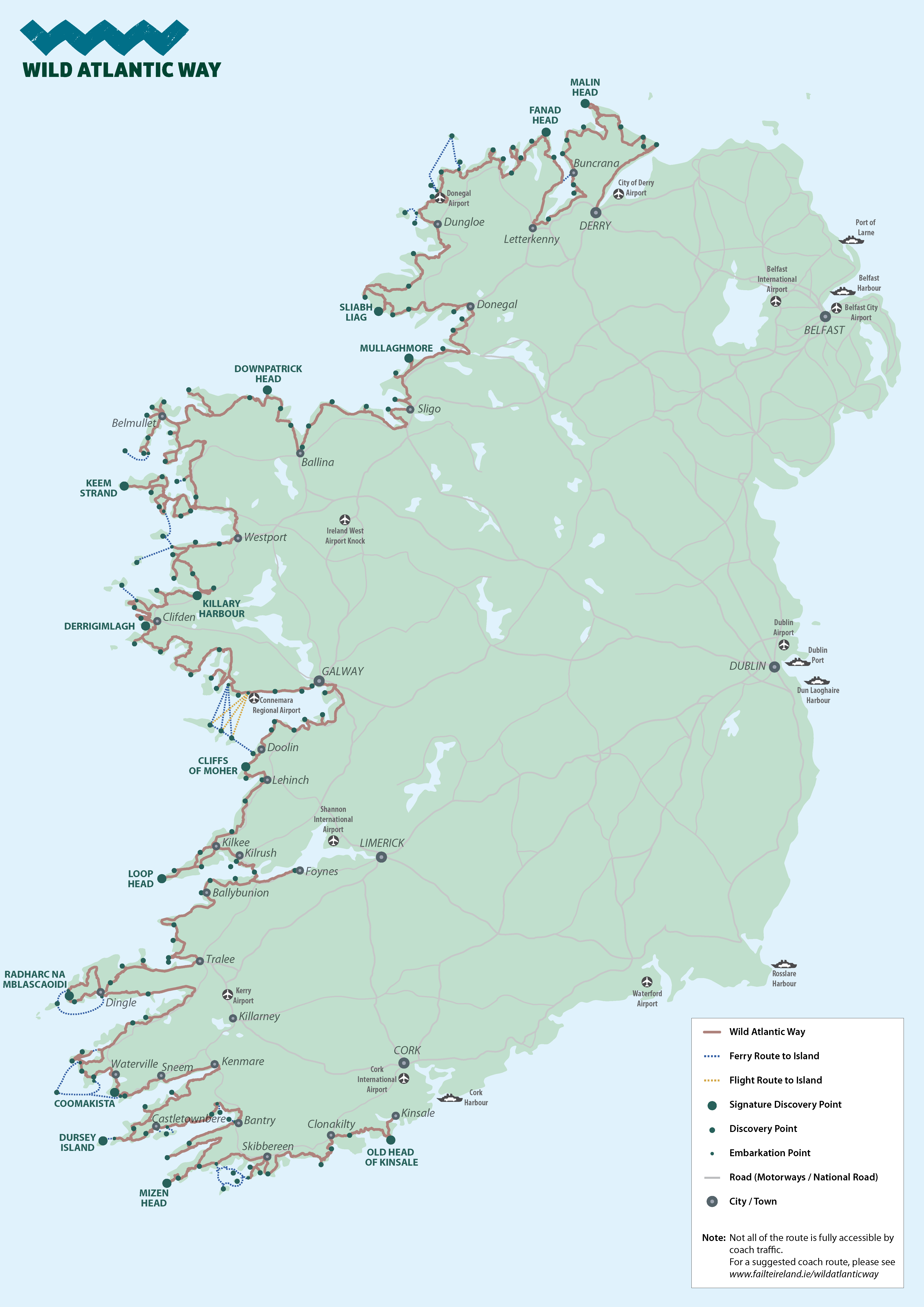
The Wild Atlantic Way is a 2500 km (approx.1550 mi.) route along the western coast of Ireland from County Donegal to County Cork. This is the itinerary I wish we could follow. Wild Atlantic Way Map Below, however, is the itinerary we hope to complete in 10 days. We’ll start in Dublin, head south to Cork and Kinsale, west to County Kerry and the Dingle Peninsula, then north to the Cliffs of Moher and Galway, and finally back east to Newgrange and Trim ending in Dublin. The entire route covers half the distance of the Wild Atlantic Way at nearly 1250 km or 800 miles. Driving on the left on narrow Irish roads promises to hold adventure with a dash of challenge.   Screen Shot 2015-04-01 at 11.59.20 AM Ten years ago we explored Dublin and the area southeast to Kilkenny and Waterford with our son, Michael. We especially enjoyed County Laois because the Lalor family, my husband’s people, are from this area. This trip, we’re looking forward to seeing an even larger area to the south and west with our son, Brian, and daughter-in-law, Abi. I’d love to have the time to stay in one place and explore an area fully but this itinerary requires that we stay in a different town each night. I’ve reserved B&B’s, guesthouses, and hotels in advance which means we have to keep to the schedule every day. I hope you’ll follow my future posts as I explore and tell you about the geography, history, and culture of this magical island.

If you’ve been to Ireland and have suggestions along our route, I’d love to hear from you. I’m especially interested in points of interest, historical sites, and restaurant recommendations.

Categories: Ireland | Tags: , , | 7 Comments

Powered by WordPress.com.